
The Follow-Up System
Here's the thing nobody tells you when you start in a law office: the work itself is not what gets you. Requesting the records is easy. Talking to the client is easy. Filing the pleading is easy.
It's the follow-ups that get you.
The records you requested thirty days ago and never chased. The client who was supposed to call back — or send photographs — and didn't. The filing you submitted via e-file never confirmed was accepted. Every paralegal I know is good at the preliminary tasks. The failures live in the follow-ups, because a follow-up has no deadline screaming at you today. It just quietly becomes a missed deadline caused by a problem somebody discovers three weeks too late. The task is not done when the request is sent.
Every task you do -e.g. request medical records, requires follow up to completion; e.g. you may need to follow up to make sure the request was received and again later when the records are due if they still have not been received. The task is not really complete until the objective has been met, e.g. records received.
Researchers who study memory have a name for part of this: unfinished tasks stay mentally "open" and keep pulling at your attention — and the list of open loops in a busy legal day is endless. You cannot hold them all in your head. Nobody can. The people who look effortlessly organized aren't remembering more. They've built a system that remembers for them, and — this is the part that matters — they actually review it.
Here's the system that runs my day.
Start: the day gets planned before it plans me
Before email, before anything, I open my daily page. Three things go at the top — my Top 3. Not ten. Three. If everything else burns down, those three still happen.
Then, before I start a single new task, I check my Follow-Ups list. A follow-up only works if you give it a date. Requested records get a chase date. I check the next day to make sure the request was received and schedule another follow up when the request is due. Callbacks owed, documents I'm waiting on, filings to verify: all of it lives on that one list, and the list gets looked at every morning, not just written and forgotten.

Aside from my lists, I have a couple other hacks to remember to follow up with important things. There’s the follow up calendar. Assign specific categories to your calendar such as events, deadlines, and follow-ups. keep track of follow-ups here.
My second hack: the schedule-send email to self. This one is highly effective for me. The moment I do a task that requires a follow-up, I draft an email to myself and schedule it to send to me on the day I need to do it using the “schedule send” feature in my outlook. Most email platforms have this feature.
End: the day closes on paper, not in my head
Before I leave, everything still rattling around gets dumped onto the brain-dump page — every loose end, half-thought, and "oh, I need to—" in one place. Then tomorrow's Top 3 gets picked from it. The research on this is simple and real: getting open loops out of your head and into a system you trust is what lets your brain actually let go of them. My evenings are mine because my desk holds the list, not me.
Writing it down also helps me keep my thoughts organized and remember what I am writing.
The whole secret, if there is one
Organization isn't a personality trait. It's a follow-up system with a review habit attached. Do the task, write the follow-up down with a date, and look at the list every single morning. That's it. That's the entire difference between the week that runs you and the week you run.
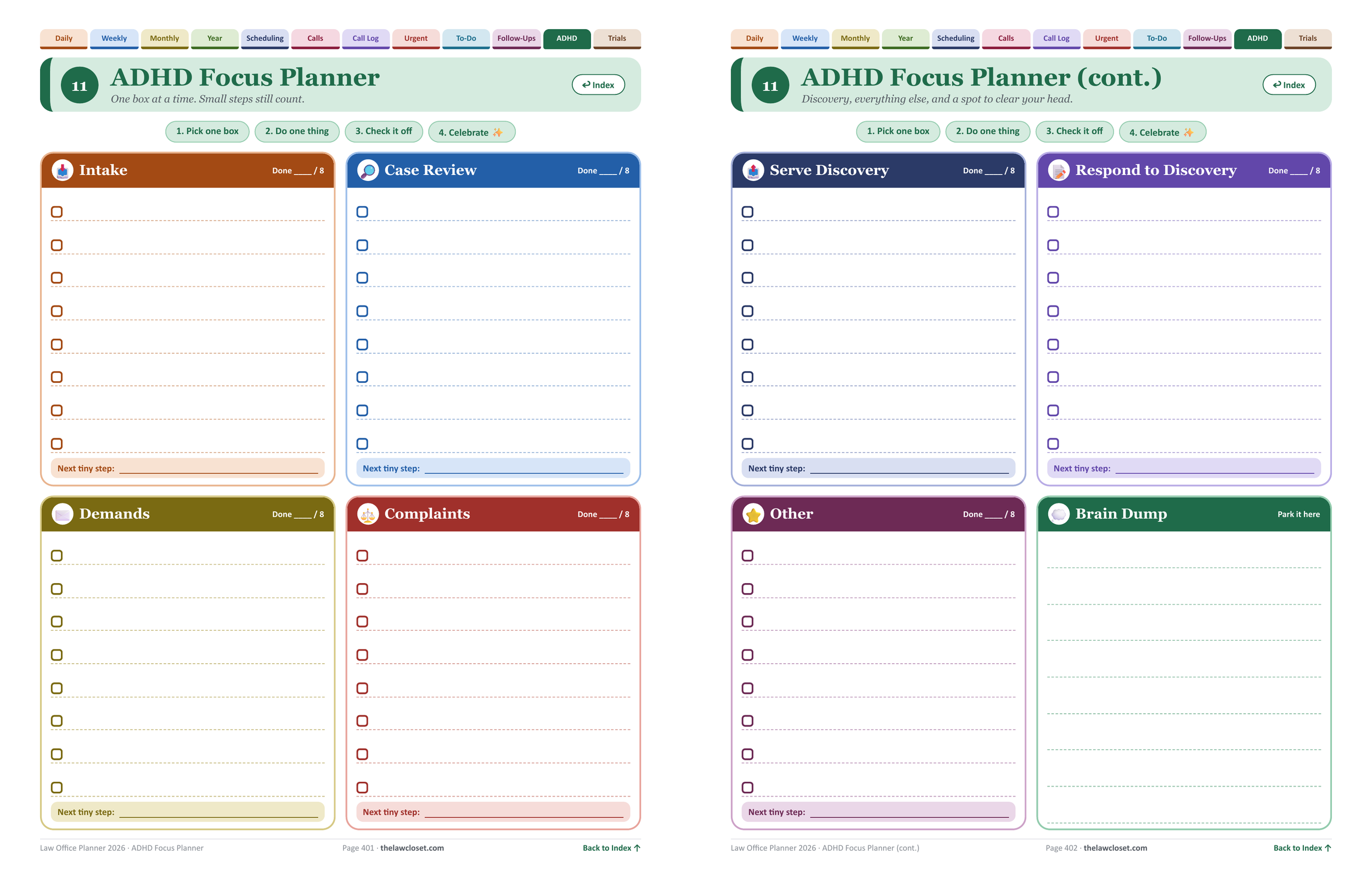
If you want to try the two pages that run my whole day, they're free — the Daily page and the ADHD Focus page are on my Freebies page. And the full planner — every tab, one tap to any page, all year long — is in the shop.
— The Law Closet
